Scabious

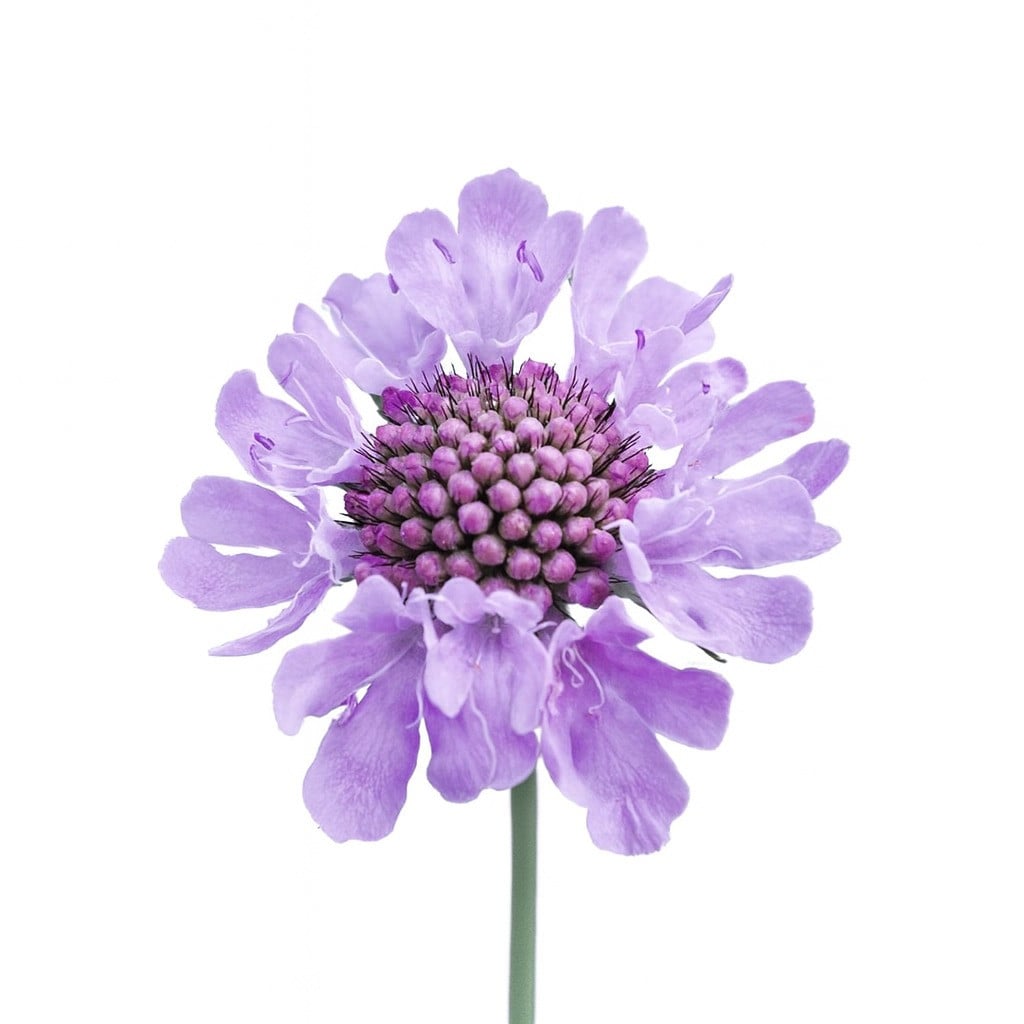
Scabious
Scabiosa
Plant family
Honeysuckle family (Caprifoliaceae)
Season Overview
Propagating
Planting
Harvest
Harvest
J
F
M
A
M
J
J
A
S
O
N
D
1ST YEAR
FOLLOWING YEARS
Details


Light requirement
Sunny

Water requirement
Dry

Soil
Light (sandy)
Nutrient requirement
Medium

Light germinator

Germination temperature
18 - 20 °C (Degrees Celsius)

Plant distance
30 cm

Row spacing
30 cm

Seeding depth
0.5 cm
Instructions
Mid of April

Pricking
Description
The scabiosa (Scabiosa) is a plant genus in the subfamily of the card family (Dipsacoideae) within the honeysuckle family (Caprifoliaceae). The approximately 100 species of the genus Scabiosa originally occur in temperate Eurasia, from Macaronesia to North Africa and from Eritrea to southern Africa. In some states of the USA and in some countries of South America, species of the genus Scabiosa occur as neophytes. Around 20 species are found in Europe. Scabiosa is also known as the widow's flower or grindweed. Beware of confusion: the same synonyms also apply to the genus Knautia. Scabioses are annual or perennial herbaceous plants. They rarely become woody at the base. The plants reach growth heights of 20 to 60 centimeters. The stems are not angular but round and have no spines, and many scabiosa species do not go completely into the ground in winter but survive with overwintering buds. Most species are hardy. Annual scabious species often self-seed. The opposite leaves are undivided to pinnate. They often form non-flowering rosettes. In many species, the basal leaves are slightly hairy. Depending on the species, scabious bloom from June to late fall. The color palette of the flowers ranges from white to red, pink and purple to blue. Butterflies, bees and other insects pollinate the pretty flowers. The flowers are in broad, long-stemmed head-shaped inflorescences surrounded by one to three rows of bracts. The flowers are hermaphrodite with a double perianth. The calyx usually ends in four to five bristles or teeth. The corolla is unevenly five-lobed. The marginal flowers are radiate. The fruits are nut-like, cylindrical, single-seeded, closed fruits with eight furrows. Scabiosa plants are grateful perennials. Numerous species of scabiosa are cultivated and are popular ornamental plants. They are suitable for rock gardens, perennial beds and borders as well as meadows. These undemanding perennials are ideal for combining with other plants. Together with soapwort, ornamental grasses or cornflowers, they form enchanting flowerbed compositions. The distinctive plants fit wonderfully into natural gardens or cottage gardens. The plants are also popular as cut and dried flowers.
Origin:
Eurasia, Macronesia, North Africa, Eritrea, South Africa
Growing tips
🌱 Pre-cultivation - From the beginning/mid-March - From April in an unheated cold frame - Fine, well-drained sowing soil - No heavily fertilized soil (scabiosas like it rather lean) - Only press seeds lightly (light germinator) - Germination temperature: 18-20 °C - Germination time: 7-14 (21) days - Evenly slightly moist, never wet. - Keep cooler after germination (approx. 12-15 °C) - Plenty of light - Prick out when 2-3 true leaves are present - Harden off: end of April/beginning of May - Plant in the bed after the last frosts - Planting distance: 25-35 cm 🌼 Direct sowing - Direct sowing: from April/May - Press seeds only lightly (light germinator) - Planting distance: 25-35 cm, depending on variety 🌞 Location - Full sun - the more sun, the more flowers - Airy, but not draughty - Ideal for flower beds, natural gardens, dry beds and as a cut flower 🌱 Soil - Well-drained, rather poor to normally nutrient-rich - Slightly moist, no waterlogging - Work in sand or fine gravel 💧 Care - Water moderately - Allow the top layer to dry out between waterings - Remove faded leaves regularly - Lightly fertilize in early summer 🌾 Overwintering - Annual varieties die back - Perennial species (e.g. Scabiosa caucasica) are usually hardy: ◦ light winter protection from leaves or brushwood ◦ good drainage in winter 🐝 Insect magnet Scabiosas are extremely popular with bees, butterflies and hoverflies - perfect for natural gardens. 🌼 Good neighbors - Yarrow, catnip, lavender, sage - Magnificent candle, echinacea, girl's eye - Feather grass, love grass, blue fescue - Verbena, oregano, thyme - Tomatoes, peppers & chili, zucchini & pumpkin - Beans, peas - Garlic & onions - Carrots, beet - Summer lilac, dog rose, wild roses - Sea buckthorn, rock pear, currants & gooseberries 🚫 Bad neighbors - Astilbe, funkia, ferns, ragwort - Phlox, delphinium, mint, goldenrod - Woodruff, fairy flower, heuchera - Salads, cabbages, celery, spinach & chard, cucumbers - Hydrangeas, rhododendrons & azaleas, privet - Willows, dogwood 🦠 Common diseases - Powdery mildew - Root rot - Leaf spot diseases 🐛 Typical pests - Aphids - snails - thrips - Caterpillars

Companion Plants
Bean ((Scarlet) runner bean)
Bean (Broad bean / Faba bean / Field bean)
Bean (Dwarf bean)
Bean (Hyacinth bean / Lablab-bean)
Bean (Lima Bean)
Bean (Runner bean)
Beetroot
Buddleja / Butterfly Bushes
Calliopsis / Tickseed
Carrots
Catnip
Chili
Coneflower (Echinacea)
Courgette / Zucchini
Currant
Garden squash - Patisson / UFO squash
Garlic
Garlic chives
Gooseberry
Grasses - Feather grasses
Grasses - Fescue
Grasses - Other
Lavender
Onion
Onion (Spring onion)
Oregano
Ornamental pumpkin
Pea
Pepper / Paprika
Pumpkin / Squash
Rock pear (Amelanchier)
Rose
Sage
Sea buckthorn
Soybean
Thyme
Tomato (Bush tomato)
Tomato (Cocktail bush tomato)
Tomato (Cocktail Stake Tomato)
Tomato (Stake tomato)
Verbena, ironweed
Yalta tomatoes
Yarrow

Antagonistic Plants
Abyssinian cabbage / Ethiopian mustard
Broccoli
Broccoli raab / Stem cabbage / Cima di rapa
Brussels sprouts
Brussels sprouts
Cabbage (Cabbage)
Cabbage (Pointed cabbage)
Cabbage (red cabbage)
Cabbage (Savoy cabbage)
Cauliflower
Celery (Celeriac / Celery root)
Celery (Celery)
Celery (Leaf celery / Chinese celery)
Chard
Chinese kale - Kai-lan / Chinese broccoli
Collard greens
Collard greens (Kale)
Collard greens (Tuscan kale / Dinosaur kale / Palm tree kale)
Cucumber / Gherkin
Dogwood
Funk
Hydrangea / Hortensia
Kohlrabi / German turnip / Turnip cabbage
Larkspur
Lettuce (Common chicory)
Lettuce (Endive / Escarole / Erisée)
Lettuce (Lamb's lettuce)
Lettuce (Lettuce)
Lettuce (Puntarelle / Cicoria di catalogna / Cicoria asparago)
Lettuce (Radicchio / Italian chicory)
Lettuce (Sugar loaf)
Make
Mint
Mizuna / Japanese mustard greens
Napa cabbage / Chinese cabbage
Pak Choi
Phlox, flame flower
Privet
Purple bellflower, silver bellflower
Quadriceps
Rapeseed
Rapeseed - Sheer cabbage / Siberian cabbage
Rapini / Broccoli rabe
Rhododendron
Spinach (Summer)
Spinach (Winter)
Sponge gourd / Egyptian cucumber / Vietnamese luffa
Sweet woodruff / Sweetscented bedstraw
Turnip
Turnip greens - Choy Sum / Chinese flowering cabbage
Turnip greens - Mizuna
Turnip greens - Tatsoi
Turnips - Oilseed turnips
Turnips - Wild turnips
Vegetable cabbage - Forage cabbage
Vegetable cabbage - Ribbed cabbage / Portuguese cabbage
Vegetable cabbage - wild cabbage / ancient cabbage
Willows
Diseases
Angular leaf spot of cucumber
Powdery mildews
Root Rot
Pests
Thrips
Land snails
Caterpillars
Aphids