Turnips - Oilseed turnips

Turnips - Oilseed turnips
Brassica rapa subsp. oleifera
Plant family
Crucifers (Brassicaceae)
Cultivation Break
4 Years
Season Overview
Sowing
Harvest
Harvest
J
F
M
A
M
J
J
A
S
O
N
D
1ST YEAR
2ND YEAR
Details


Light requirement
Sunny

Water requirement
Moist

Soil
Medium (loamy)
Nutrient requirement
Medium

Dark germinator

Germination temperature
12 - 20 °C (Degrees Celsius)

Plant distance
20 cm

Row spacing
40 cm

Seeding depth
1.5 cm
Instructions
Description
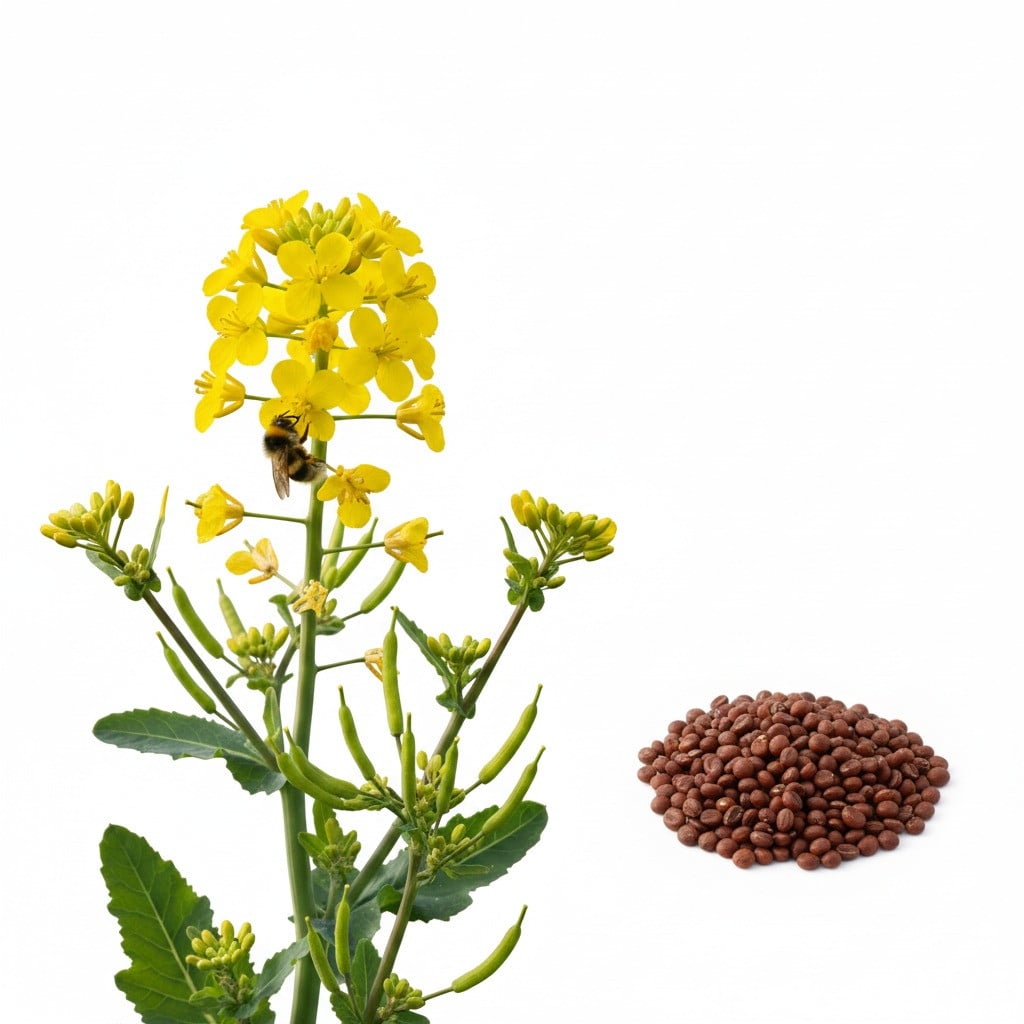
The oilseed rape (Brassica rapa subsp. oleifera) is an oilseed from the cruciferous family, similar to the closely related rapeseed (Brassica napus). Both the seeds and the whole plant are usually called turnip rape, turnip seed or turnip seed - names that are also used for the superordinate species Brassica rapa. On the mountain road, it is also called turnip rape. Important distinguishing features from rapeseed are the fresh green, only slightly frosted, hairy leaves (in contrast to the bluish frosted, only sparsely hairy leaves of rapeseed) and the smaller, reticulated seeds which, in addition to being used to produce rapeseed oil, are also used as an ingredient in bird food mixtures (for canaries, for example). It is rather unpopular in many countries as it produces poorer harvests than the very similar rapeseed.
Origin:
Eurasia, Central Asia, Mediterranean region
Growing tips
Light requirement: Light Soil composition: loamy soil, sandy soil Soil moisture: fresh Soil nutrient content: alkaline, nutrient-rich Turnip rape or field mustard has a high tolerance to lower temperatures, which is significantly higher than that of rapeseed. It survives cold and snow-free winters well. Turnip rape seeds can be sown as a catch crop in winter or as the main crop in spring. When sown in September, it produces green fodder as early as mid-April. Turnip rape produces the richest harvests on fertile soils that are rich in humus and calcium. It should not be cultivated on acidic soils. It is sown after the chickens, but is sometimes used as a pre-crop for beet as it reduces the number of nematodes in the soil.

Companion Plants
Barley
Bean ((Scarlet) runner bean)
Bean (Broad bean / Faba bean / Field bean)
Bean (Dwarf bean)
Bean (Hyacinth bean / Lablab-bean)
Bean (Lima Bean)
Bean (Runner bean)
Chives
Coriander / Cilantro
Dill
Garlic
Leeks
Lettuce (Common chicory)
Lettuce (Endive / Escarole / Erisée)
Lettuce (Lamb's lettuce)
Lettuce (Lettuce)
Lettuce (Puntarelle / Cicoria di catalogna / Cicoria asparago)
Lettuce (Radicchio / Italian chicory)
Lettuce (Sugar loaf)
Lupine / Bluebonnet
Oats
Onion
Onion (Spring onion)
Pea
Rye
Soybean
Spinach (Summer)
Spinach (Winter)
Sunflower
Sweet lupins

Antagonistic Plants
Abyssinian cabbage / Ethiopian mustard
Aubergine / Eggplant
Broccoli
Broccoli raab / Stem cabbage / Cima di rapa
Brussels sprouts
Brussels sprouts
Cabbage (Cabbage)
Cabbage (Pointed cabbage)
Cabbage (red cabbage)
Cabbage (Savoy cabbage)
Cauliflower
Chinese kale - Kai-lan / Chinese broccoli
Collard greens
Collard greens (Kale)
Collard greens (Tuscan kale / Dinosaur kale / Palm tree kale)
Fennel
Florence fennel / Finocchio
Kohlrabi / German turnip / Turnip cabbage
Napa cabbage / Chinese cabbage
Okra
Pepper / Paprika
Radish
Radishes
Rapeseed
Rapeseed - Sheer cabbage / Siberian cabbage
Rutabaga / Swedish turnip
Sea coal
Tomato (Bush tomato)
Tomato (Cocktail bush tomato)
Tomato (Cocktail Stake Tomato)
Tomato (Stake tomato)
Vegetable cabbage - Forage cabbage
Vegetable cabbage - Ribbed cabbage / Portuguese cabbage
Vegetable cabbage - wild cabbage / ancient cabbage
Diseases
Root Rot
Club root of cabbage
Angular leaf spot of cucumber
Powdery mildews
Pests
Stem borers
Land snails
Leaf-miner flies
Flea beetles
Aphids
Voles