Dill

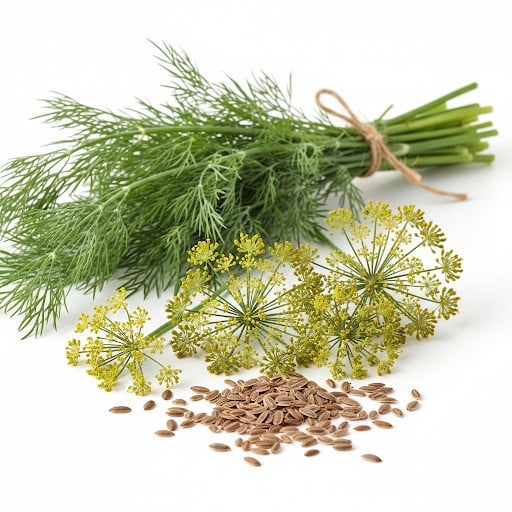
Dill
Anethum
Plant family
Umbellifers (Apiaceae)
Cultivation Break
4 Years
Season Overview
Sowing
Harvest
J
F
M
A
M
J
J
A
S
O
N
D
Details


Light requirement
Sunny

Water requirement
Dry

Soil
Light (sandy)
Nutrient requirement
Medium

Light germinator

Germination temperature
15 - 20 °C (Degrees Celsius)

Plant distance
12 cm

Row spacing
25 cm

Seeding depth
0.5 cm
Instructions
End of March

Propagating
End of March

Harden
Mid of April

Transplanting
End of April
Planting
Every week
End of April
Fertilizing
Description
Dill is an annual, deep-rooting herb of the umbellifer family with various subspecies (garden dill, field dill and Indian dill). Essential oils provide the intense fragrance of the popular medicinal and spice herb.
Origin:
Southeast Asia
Growing tips
Dill seeds can be collected and used for replanting the following year. To do this, you can collect them when they turn brown. Dill is a dark seedling, its perfect germination temperature is 10°C. To harvest, simply pick off the shoot tips during the harvest period. Dill prefers a wind-protected location, as the leaf stalks snap off easily. It is also sensitive to irregular water supply.

Companion Plants
Abyssinian cabbage / Ethiopian mustard
Asparagus
Basil
Bean ((Scarlet) runner bean)
Bean (Broad bean / Faba bean / Field bean)
Bean (Dwarf bean)
Bean (Hyacinth bean / Lablab-bean)
Bean (Lima Bean)
Bean (Runner bean)
Beetroot
Borage
Broccoli
Broccoli raab / Stem cabbage / Cima di rapa
Brussels sprouts
Brussels sprouts
Cabbage (Cabbage)
Cabbage (Pointed cabbage)
Cabbage (red cabbage)
Cabbage (Savoy cabbage)
Cauliflower
Chard
Chinese kale - Kai-lan / Chinese broccoli
Chives
Chives
Collard greens
Collard greens (Kale)
Collard greens (Tuscan kale / Dinosaur kale / Palm tree kale)
Common marigold
Coneflower (Echinacea)
Corn / Maize
Courgette / Zucchini
Cucumber (African horned cucumber / Kiwano)
Cucumber (Caigua)
Cucumber (Melothria)
Cucumber / Gherkin
Currant
Garden squash - Patisson / UFO squash
Garlic
Garlic chives
Gooseberry
Hair cucumbers / snake gourds
Kohlrabi / German turnip / Turnip cabbage
Leeks
Lettuce (Common chicory)
Lettuce (Endive / Escarole / Erisée)
Lettuce (Lamb's lettuce)
Lettuce (Lettuce)
Lettuce (Puntarelle / Cicoria di catalogna / Cicoria asparago)
Lettuce (Radicchio / Italian chicory)
Lettuce (Sugar loaf)
Melon (Sugar melon)
Melon (Watermelon)
Mizuna / Japanese mustard greens
Napa cabbage / Chinese cabbage
Nasturtium
Okra
Onion
Onion (Spring onion)
Ornamental alliums
Pak Choi
Pea
Phlox, flame flower
Rapeseed
Rapeseed - Sheer cabbage / Siberian cabbage
Rapini / Broccoli rabe
Raspberry
Rudbeckia (Coneflower / Black-eyed-susans)
Rutabaga / Swedish turnip
Soybean
Spinach (Summer)
Spinach (Winter)
Sponge gourd / Egyptian cucumber / Vietnamese luffa
Sunflower
Sweet potato
Turnip
Turnip greens - Choy Sum / Chinese flowering cabbage
Turnip greens - Mizuna
Turnip greens - Tatsoi
Turnips - Oilseed turnips
Turnips - Wild turnips
Vegetable cabbage - Forage cabbage
Vegetable cabbage - Ribbed cabbage / Portuguese cabbage
Vegetable cabbage - wild cabbage / ancient cabbage
Wild garlic

Antagonistic Plants
Aubergine / Eggplant
Caraway / Meridian fennel / Persian cumin
Celery (Celeriac / Celery root)
Celery (Celery)
Celery (Leaf celery / Chinese celery)
Chili
Coriander / Cilantro
Cress
Fennel
Florence fennel / Finocchio
Lavender
Lovage
Nightshades (Other)
Parsley
Pimpinella
Root parsley
Rosemary
Sage
Stem herbs
Thyme
Tomato (Bush tomato)
Tomato (Cocktail bush tomato)
Tomato (Cocktail Stake Tomato)
Tomato (Stake tomato)
Tuberous zizyphus
Turnip-rooted chervil
Diseases
Root Rot
Downy mildew
Powdery mildews
Pests
Land snails
Spider mites
Aphids
Root knot nematodes
Nematodes