Sea coal

Sea coal
Crambe
Plant family
Crucifers (Brassicaceae)
Cultivation Break
4 Years
Season Overview
Propagating
Planting
Harvest
Harvest
J
F
M
A
M
J
J
A
S
O
N
D
1ST YEAR
FOLLOWING YEARS
Details


Light requirement
Sunny

Water requirement
Moist

Soil
Light (sandy)
Nutrient requirement
Medium

Dark germinator

Germination temperature
15 - 18 °C (Degrees Celsius)

Plant distance
50 cm

Row spacing
70 cm

Seeding depth
1.5 cm
Instructions
Description
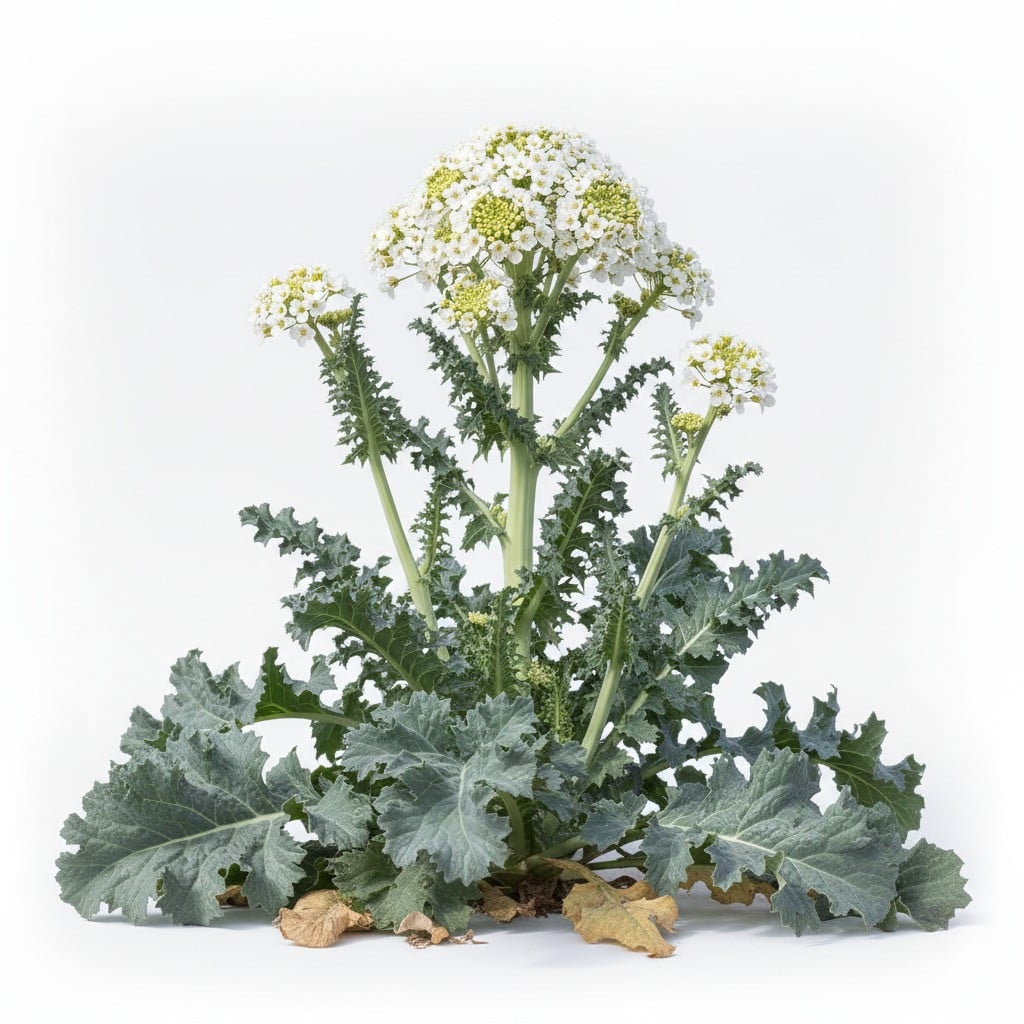
Sea kale (bot. Crambe) is a plant genus in the cruciferous family (Brassicaceae) within the order Brassicales. The genus comprises 34 to 37 species, which are found from central Europe to western Asia. The different types of sea kale each have their own unique benefits. The true sea kale (Crambe maritima) plays an important role as a wild and useful plant in the diet. The appearance of its large wavy leaves in a grey-green color is decisive for its name. The species crambe (Crambe hispanica) is an oil plant and is used as a renewable raw material for oils and waxes. In its wild form, sea kale grows wild on the beaches of the Atlantic, the Black Sea and the Baltic Sea. The wild plants are now protected. Some edible species are considered a delicacy in France, the USA, the Netherlands and England, where they grow on a large scale in cultivated form. As a coastal plant, they are an excellent choice for revegetating saline soils. In our native gardens, the giant crambe (Crambe cordifolia) is probably the best-known representative of this genus. Distribution The representatives of the genus Crambe are found from central Europe to western Asia. In the south, they thrive as far as the regions of northern Africa. They can be found on the Canary and Macaronesian Islands. Eight species are native to Europe. The giant gypsophila originally comes from the northern Caucasus and today grows in large parts of Russia, in the Ukraine and as far as Siberia. The species Crambe kotschyana thrives in Central Asia, in the northwest of the Himalayas and in the north of Iran. Tatarian sea kale (Crambe tataria) is a wild plant from the steppe regions of eastern and southern Europe. In Western Europe, the species is considered a post-glacial cold steppe relict. The slender sea kale (Crambe strigosa) is endemic to the Canary Islands. This term describes plants which, in contrast to the globally distributed species, occur in a specific, spatially delimited area. The true sea kale (Crambe maritima) now thrives in the wild in Germany. It occurs on fallow land with a high groundwater table. Leaf The leaves of the sea kale are on long stalks. They are oval to elongated and wavy. The leaves vary in color between dark green and blue-grey to grey-green. They reach a length of between five and fifteen centimetres and a width of between ten and twenty centimetres. Flower The flowers of the sea kale are hermaphrodite and four-petaled. They have four white petals. These show the characteristic cruciform position of cruciferous plants. The small white flowers have a strong fragrance and grow in large umbels at the tips of the shoots. The inflorescence is strongly branched. The sea kale begins to flower in early summer from the beginning of May. The sea kale is pollinated by insects (zoophily). Fruit Representatives of the genus Crambe develop branched pods as fruit. One seed ripens in each of these. This seed is a spherical nut-shaped fruit. Growth Sea kale species are perennial plants with a herbaceous growth habit. Each plant forms a taproot that extends far into the soil. Sea kale is hardy and reaches a height of 40 to 180 centimeters. The giant gypsophila is by far the tallest growing species of the genus. The leaves of the sea kale sit on tall, branched stems. In addition to the taproot, the plants form fleshy, thick roots that branch out abundantly.
Origin:
Europe, West Asia, North Africa (coastal areas)
Growing tips
Location Sea kale species prefer a predominantly sunny to semi-shady spot to thrive. Sun is essential for all species of the genus, otherwise they will wither. In the garden, they like to grow in an airy position, in keeping with their natural habitat. Wind does not harm the plants. On the contrary: the plants feel most at home in a fresh breeze. They love well-drained, loamy-sandy soils. The soil should ideally contain plenty of nutrients and provide sufficient moisture. Sea kale is only suitable for mixed cultivation to a limited extent; most species prefer to stand alone in the bed. Care/pruning Sea kale is sown in spring in pots or directly into the open ground. Pre-soaking the seeds in water for 24 hours accelerates germination when sowing. After one to two weeks, it is advisable to move the young plants. Young plants require a space of around 60 square centimetres as soon as they have leaves. Propagation by root or tip cuttings proves to be easier. The cuttings grow in pots or beds in moist soil and take root within a few weeks. Sea kale requires a regular supply of water. However, it does not tolerate waterlogging as it tends to rot in stagnant water. Many of the species that thrive in our gardens are happy to receive a small amount of fertilizer regularly, preferably composted manure. Removing the inflorescences of edible species maximizes the harvest. Utilization The benefits of sea kale vary depending on the species. The true sea kale, known as sea kale or beach kale, used to be used as a fodder plant. The species is now a protected species. It thrives as a halophyte (salt plant that adapts to the high salt content of its natural habitat) on salty and barren soils in coastal areas. In cultivated form, it is used in domestic gardens as an ornamental plant or vegetable, as this species is edible. Crambe maritima is similar to asparagus in its preparation. The sea kale is extremely rich in vitamins, its leaves and stems are juicy and mild in taste. It is suitable as an accompaniment to meat and fish dishes. Diseases/pests All species of the sea kale genus are considered robust and vital plants. They are not susceptible to diseases such as cabbage hernia or downy mildew. Sea kale is rarely attacked by pests. Slugs and snails like to eat its leaves. The whitefly and cabbage white butterfly avoid sea kale. Rotting occurs if the plant is waterlogged or planted too close together or in an insufficiently airy location.

Companion Plants

Antagonistic Plants
Abyssinian cabbage / Ethiopian mustard
Bean (Dwarf bean)
Bean (Runner bean)
Broccoli
Broccoli raab / Stem cabbage / Cima di rapa
Brussels sprouts
Brussels sprouts
Cabbage (Cabbage)
Cabbage (Pointed cabbage)
Cabbage (red cabbage)
Cabbage (Savoy cabbage)
Cauliflower
Chinese kale - Kai-lan / Chinese broccoli
Collard greens
Collard greens (Kale)
Collard greens (Tuscan kale / Dinosaur kale / Palm tree kale)
Courgette / Zucchini
Cucumber / Gherkin
Kohlrabi / German turnip / Turnip cabbage
Lettuce (Lettuce)
Melon (Sugar melon)
Napa cabbage / Chinese cabbage
Okra
Pepper / Paprika
Potato
Rapeseed - Sheer cabbage / Siberian cabbage
Sage
Thyme
Tomato (Bush tomato)
Tomato (Cocktail bush tomato)
Tomato (Cocktail Stake Tomato)
Tomato (Stake tomato)
Vegetable cabbage - Forage cabbage
Vegetable cabbage - Ribbed cabbage / Portuguese cabbage
Vegetable cabbage - wild cabbage / ancient cabbage
Diseases
Root Rot
Pests
Land snails