Orchids - Ragwort / Kerfstendel

Orchids - Ragwort / Kerfstendel
Ophrys
Plant family
Orchid family (Orchidaceae)
Cultivation Break
0 Years
Season Overview
Sowing
Harvest
Harvest
J
F
M
A
M
J
J
A
S
O
N
D
1ST YEAR
FOLLOWING YEARS
Details


Light requirement
Sunny

Water requirement
Dry

Soil
Light (sandy)
Nutrient requirement
Low

Light germinator

Plant distance
10 cm

Row spacing
15 cm

Seeding depth
3 cm
Instructions
Description
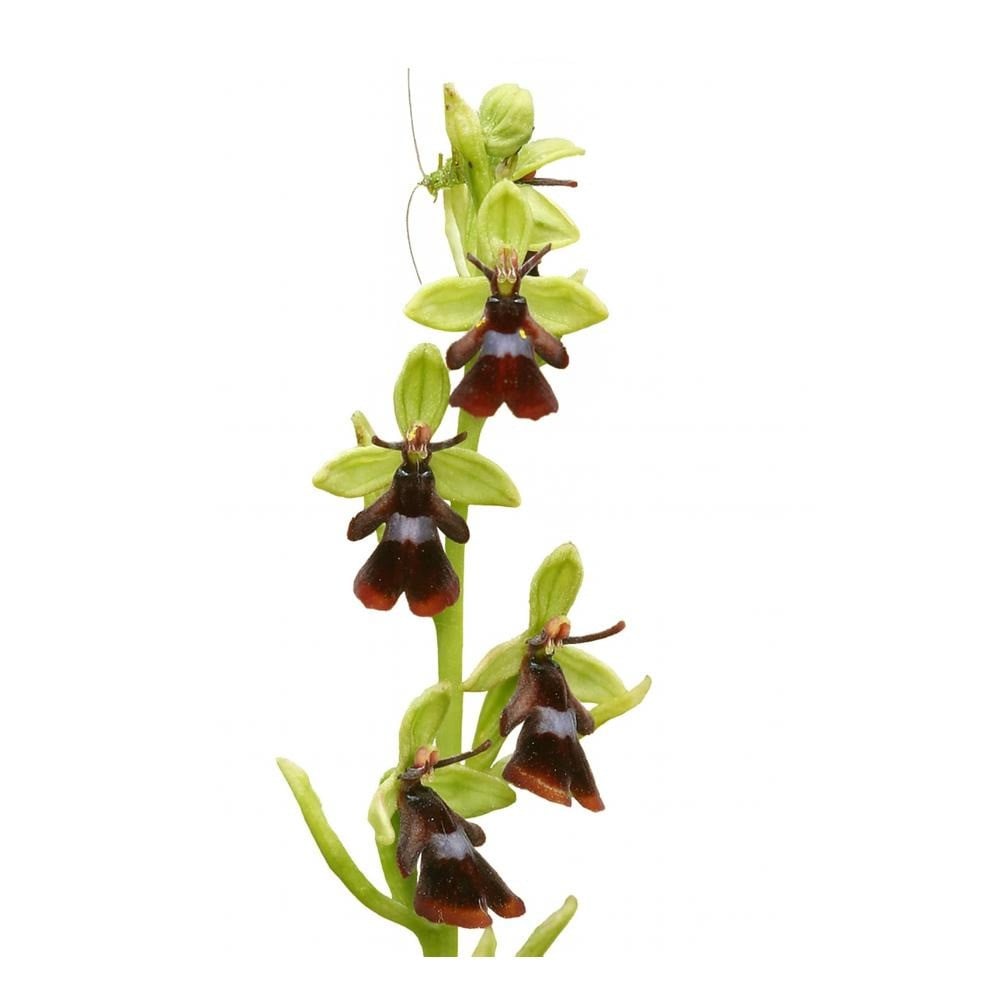
Ragworts (Ophrys), also known as Kerfstendel, are a plant genus in the orchid family (Orchidaceae). They are mainly found around the Mediterranean and survive the dry summer with the help of an underground bulb. For pollination, the flowers attract male insects through the production of scents and their insect-like appearance, which transfer pollen when they attempt to copulate with the flowers. The genus comprises 10 to 350 species, depending on opinion. The botanical genus name Ophrys is derived from the Greek word ophrys for "eyebrows". The "term" Ophrys was first mentioned by Pliny the Elder in his work Naturalis historia. Growth The ragwort species are relatively small, perennial, herbaceous plants. They usually reach heights of 10 to 40 centimetres, but there are also flowering specimens that are only 5 centimetres high, while other species reach up to 90 centimetres. They survive the unfavorable season with an underground tuber. During the growing season, this tuber is replaced by one, rarely two new ones. The tubers are roundish to slightly oval and are formed partly from root tissue and partly from shoot tissue. They contain living cells that store starch and dead cells that store water. The fibrous roots emerge from the shoot above the tubers. The leaves are arranged in a basal rosette, and other smaller leaves may also be arranged on the stem; or the leaf rosette is loose with leaves distributed along the stem. A few flowers are loosely arranged in a terminal, racemose inflorescence. The ovary is sessile, not hairy and not or only slightly twisted. The flowers are resupinate, relatively large, conspicuous and resemble an insect. The hermaphrodite flowers are zygomorphic and tripinnate. The perianths are not fused together. The three outer petals (sepals) are white, pinkish or greenish, usually glabrous. The lateral petals are smaller than the outer petals and hairy. The lip is entire to three-lobed, often with an appendage or a pointed tip at the end. The lip is usually convexly curved, although the tip can be curved upwards in the opposite direction. In contrast to related genera, the lip of the ragwort has no spur. At the base of the lip there is a conspicuously colored area in the middle, to the side of which there are often two elevations. In the middle of the lip is a smooth, often shiny surface, towards the edge the lip is hairy. The column combines the stigma and the stamen; between the two lies the sparsely developed separating tissue (rostellum), which often has two small, colored lateral outgrowths. The two pollinia are connected by pedicels, each with a separate adhesive disk (viscidium). Pollination Orchids of the genus Ophrys are known for their special pollination mechanism. In Ophrys species, the lip of a flower is an imitation of a female insect. Male insects can be deceived and transfer the pollen during a so-called pseudocopulation. This phenomenon is called sexual deception and is a form of mimicry (lure mimicry). The sensory components of sexual deception are composed of olfactory (scent), visual (color, shape) and tactile (hairiness) stimuli. The scent of the flowers, in many species a mixture of low-volatility hydrocarbons imperceptible to the human nose, is the most important stimulus for specifically attracting male pollinators. It is an "almost" exact copy of the sexual scents of female insects and therefore triggers the same search and copulation behavior as the corresponding female scents. Tactile stimuli are of particular importance. Depending on the orientation of the pubescence, a male insect recognizes where the "front" and "back" of a female is. The orientation of the hairs on Ophrys flowers therefore determines whether the pollinator attempts to copulate with the flowers "head first" or "abdomen first". Accordingly, the pollinia are removed and transported with the head or the posterior body (abdomen). The consequence of the sexual deception mechanism is a certain specificity in pollination, because attraction via sexual scents is relatively specific, but unspecific in the heat of the moment. The result is therefore countless hybrids. In most cases, the pollinators are solitary bees, for example of the genera Andrena, Eucera, Anthophora etc. A few Ophrys species are pollinated by digger wasps (Ophrys insectifera), dagger wasps (Ophrys speculum), beetles, flies (Ophrys fuciflora) or plant wasps (Ophrys insectifera var. subinsectifera). Due to this dependence of Ophrys species on their respective pollinators, the protection of orchids should therefore always take into account the protection of the corresponding pollinating insects.
Origin:
Europe, Middle East, Mediterranean region
Growing tips
Location Light: Sunny to semi-shady, warm spots are ideal. Soil: Lime-rich, well-drained, nutrient-poor, rather dry. Suitable for: Nutrient-poor grassland, dry meadows, rock gardens, semi-natural areas. Planting Time: Fall or spring. Tubers: Plant flat, soil not too nutrient-rich. Spacing: 15-20 cm, as they form small clumps. Care Watering: Only water lightly during longer dry periods. Avoid waterlogging at all costs. Fertilization: No fertilization - they prefer lean soils. Hardiness: Fully hardy down to -20 °C. Propagation: By seed (slow, requires mycorrhizal fungi). Vegetatively by tuber formation. Special features Flowering time: April to June, depending on species. Flowers: Decoy flowers - imitate insects (e.g. bee, fly, bumblebee orchid). Height: 15-40 cm. Species diversity: Over 200 species and subspecies in Europe and the Mediterranean region. Ecological importance: Highly specialized pollination strategies, important for biodiversity.


Antagonistic Plants
Diseases
Root Rot
Grey mold
Fusarium
Pests
Land snails
Voles