False cypresses

False cypresses
Chamaecyparis
Plant family
Cypress family (Cupressaceae)
Season Overview
Propagating
Planting
Harvest
J
F
M
A
M
J
J
A
S
O
N
D
1ST YEAR
FROM YEAR 5
Details


Light requirement
Sunny

Water requirement
Moist

Soil
Medium (loamy)

Nutrient requirement
Medium

Light germinator

Germination temperature
15 – 20 °C (Degrees Celsius)

Plant distance
200 cm

Row spacing
200 cm

Seeding depth
1.5 cm
Instructions
Description
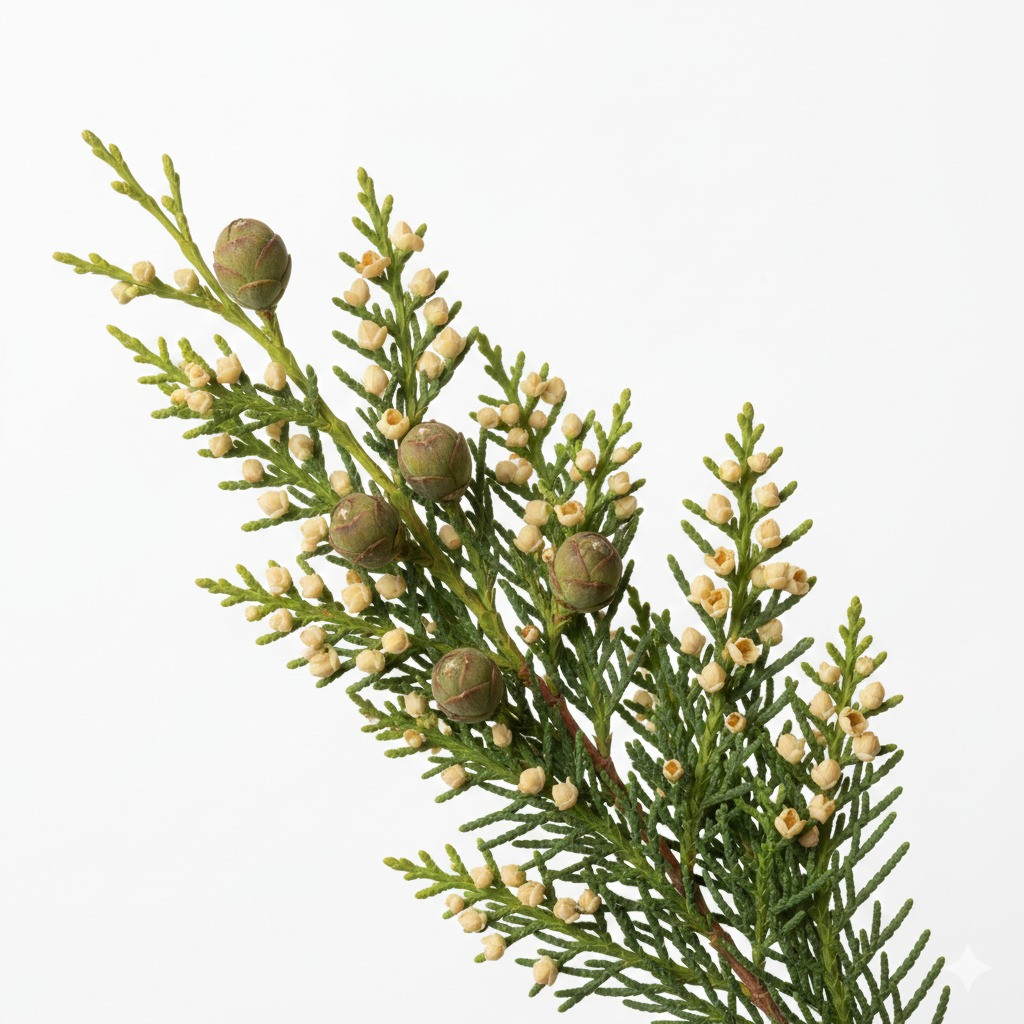
The genus of false cypresses (Chamaecyparis) belongs to the cypress family (Cupressaceae) and is closely related to the true cypress (Cupressus sempervirens) from the Mediterranean region. Six species of "false cypress" are known to date, which are widespread in northern North America and East Asia. They are evergreen conifers, some of which look very similar to the arborvitae (Thuja). They differ from these in that they usually grow more upright and weaker and have roundish cones. Arborvitae usually grow somewhat more vigorously and sprawling, and they also bear small, elongated cones. The color palette is also wider in the varieties of false cypresses than in arborvitae - there are hardly any varieties with blue-grey scales in the genus Thuja, for example. Only four species of mock cypress are in demand as garden plants, of which Lawson's mock cypress (Chamaecyparis lawsoniana) is the most important. They are available in numerous varieties, most of which form columnar to conical crowns, some of which are also compact and round. The color palette includes various shades of green, yellow, grey and blue. The most vigorous varieties, such as the steel-blue 'Alumii', can also grow up to 15 meters high in Germany, while the dwarf form 'Pygmea Argentea' only grows to just over one meter high. Also widespread in gardens is the Sawara cypress (Chamaecyparis pisifera), which usually grows broadly upright and appears somewhat more delicate, as well as the thread cypress (Chamaecyparis pisifera var. filifera) or the yellow thread cypress and green thread cypress, mutations with thread-like, overhanging shoots that usually grow in a flat ball to cushion shape. There are also species of these plants with different leaf colors. The Alaskan cypress (Chamaecyparis nootkatensis) grows upright like a column with overhanging branch tips and forms a picturesque crown with age. The beautiful pendulous growth habit is particularly pronounced in the 'Pendula' variety. The Hinoki cypress (Chamaecyparis obtusa), also known as shell cypress, tends to grow in a broad bush or cushion shape and slowly. The yellow-leaved 'Aurora', which does not grow taller than 80 to 100 centimetres, or the equally large, green-leaved variety 'Nana Gracilis' are popular. All false cypresses have strongly flattened branches with scale-like needles, roundish cones about the size of a pea and, depending on the variety, usually slightly inclined to strongly overhanging shoot tips. False cypresses are monoecious, i.e. they bear only male and only female flowers on one plant. The male flowers, which are the size of a pinhead, appear in large numbers at the tips of the shoots. They are initially bright orange-red in color and then dry to a dark brown.
Origin:
Alaska, Canada, East Asia
Growing tips
False cypresses like sunny to semi-shady, sheltered locations with fresh to moist, sandy-loamy soil that can be alkaline to slightly acidic. In general, false cypresses prefer cool, humid places. They are more tolerant of shade and drought than arborvitae, but are also somewhat more sensitive to frost. All parts of the plant are poisonous, contact with them can cause skin irritation and ingestion can lead to nausea and vomiting. Lawson's false cypress, also known as Oregon cedar, and the Als cypress are also very important for forestry in their native North America. They provide a light but very durable wood that is often used for building houses and boats, among other things. Uses The gardening world is as polarized by mock cypresses as it is by the related arborvitae. For many amateur gardeners, they are typical cemetery plants that have no place in the garden. Ultimately, however, it always depends on how you use the plants in the garden. Pure mock cypress plantings of different varieties don't exactly look natural. However, if varieties such as the Hanging Alaskan Cypress are used as specimen trees, they will not fail to make an impact. The dwarf forms are particularly popular for grave planting, but in recent years they have also been increasingly used as easy-care, evergreen, hardy container plants. They also fit well in rock gardens or heather gardens. The upright-growing varieties of Lawson's cypress are particularly popular as evergreen hedge plants. Narrow, opaque and low-maintenance hedges can be created from varieties such as 'Alumii' or 'Columnaris'. If you want to use mock cypresses in the garden, they should preferably be planted as specimen trees or in small groups. Resist the urge to plant a hodgepodge of different varieties and foliage colors, but rather combine several mock cypresses of the same variety with deciduous or evergreen deciduous shrubs. It is also common to see colorful hedges in gardens with alternating yellow and blue mock cypress varieties. Of course, this is also a matter of taste, but aesthetically speaking it is at least questionable. Mock cypresses are also very popular for growing garden bonsais. They are often used to grow bizarre specimens with several bare main branches that are only leafy at the tips. Columnar specimens with spirally arranged foliage are also very popular. Pruning The good news about pruning the mock cypress is that it is very tolerant of pruning. Hedges should ideally be pruned once a year around St. John's Day. It is important to prune every year, as mock cypress hedges that have not been pruned for several years are not so easy to get back into shape. The reason for this is that mock cypresses and arborvitae do not sprout again from the older branches after severe pruning. Therefore, do not cut the hedge back any further than the area that is still covered with scales. You should shape garden bonsai at least twice a year - but here, too, you must bear in mind that a branch or trunk that has been stripped of its side branches will remain bare in these areas forever. Further care Freshly planted mock cypresses in particular should be watered promptly and thoroughly in dry conditions. Additional watering is also sometimes important in winter after long periods of frost if there has been no rainfall for a long time. Specimens cultivated as tub plants need a shady spot in winter without direct sunlight, and the plant container should also be insulated against the cold. Tub plants should be regularly fed with liquid green plant fertilizer during the season, while outdoor plants only need compost in spring. Propagation The wild species of false cypress can be propagated by sowing. They also set seed in our latitudes, but are rarely available in garden shops and are also rarely planted. Most varieties of Chamaecyparis lawsoniana and Chamaecyparis pisifera are propagated by cuttings. As with the arborvitae, so-called cuttings are used, i.e. side branches obtained by tearing off the main shoots. Propagating cuttings is more difficult with most varieties of Chamaecyparis obtusa and Chamaecyparis nootkatensis. The varieties of shell cypress sometimes grow very slowly as young plants propagated by cuttings, which is why they are grafted onto seedlings of Lawson's mock cypress in the summer by side-grafting. The hanging form 'Pendula' of the Alaskan cypress is grafted onto seedlings of the wild species, as it is incompatible with Lawson's false cypress. Diseases and pests Mock cypresses can be attacked by the thuja leaf miner and various fungal diseases can lead to browned shoot tips. Brown shoots or parts of shoots can also be caused by a lack of water, waterlogging, road salt or late frost.


Antagonistic Plants
Diseases
Root Rot
Pests
Leaf-miner flies