Grasses - reeds, cattails, bulrushes

Grasses - reeds, cattails, bulrushes
Phragmites, Arundo donax, Typha
Plant family
Grass family (Poaceae)
Season Overview
Sowing
Harvest
Harvest
J
F
M
A
M
J
J
A
S
O
N
D
1ST YEAR
FOLLOWING YEARS
Details


Light requirement
Sunny

Water requirement
Wet

Soil
Medium (loamy)
Nutrient requirement
Medium

Dark germinator

Germination temperature
20 – 25 °C (Degrees Celsius)

Plant distance
100 cm

Row spacing
100 cm

Seeding depth
1 cm
Instructions
Description
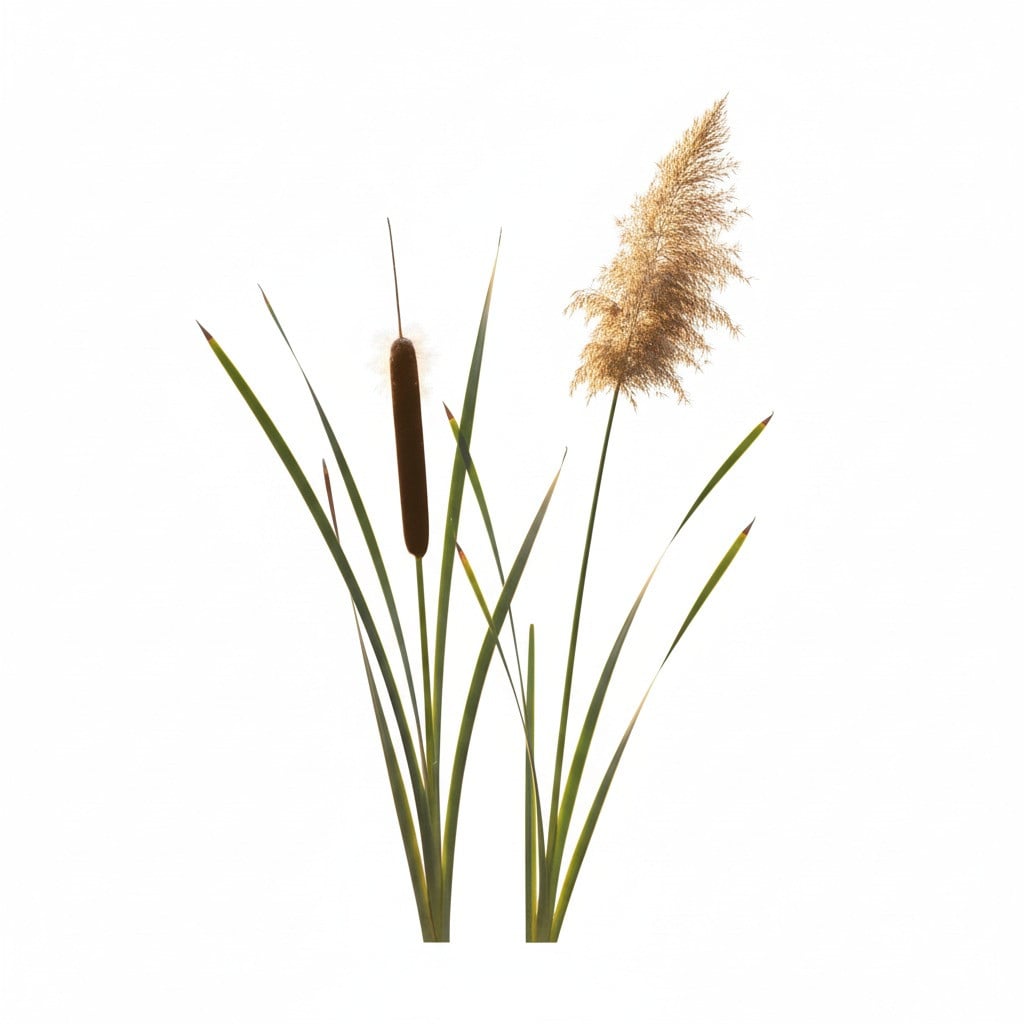
Reed canes are perennial plants that grow up to six meters high. The grasses are easily recognized by their tall, slender stems. Their leaves are long, narrow and sharply serrated. The tips are blunt or tapering. In late summer to autumn, they bear striking, feathery inflorescences that can vary from golden brown to purple. Arundo donax is a clump-forming grass with strong, tightly upward-growing shoots that is winter-green in Central Europe. This giant grass can easily reach a height of four meters. The upright stems, which are around three centimetres thick, arise from a bulbous, thickened rhizome that runs close to the ground but, unlike many bamboo species, does not tend to proliferate. Linear, mostly basal leaves are typical of all cattail species. They are alternate on a hairless stalk and are arranged strictly in two rows. The leaves of the plants grow strictly upright and can be up to four meters long. Adapted to their aquatic habitat, they consist of a floating tissue that can be compressed like a sponge. Parallel nerves are clearly visible on the leaf surface. The blades are curved outwards, forming a semicircle in cross-section. The leaf sheaths are open. Between the leaves are brown inflorescences in a distinctive cob shape. These are usually shorter than the leaf tips. It is striking that male and female flowers stand in groups on an inflorescence, the thinner male flowers usually at the top, the thicker female flowers at the bottom. Pollination of the densely packed individual flowers, which appear in early to midsummer, is carried out by the wind. The single flower consists of an ovary on a stalk, the perianth is reduced to a ring of hairs. There are also several stamens on a stalk. They are framed by a number of involucral bristles. The seed consists of a single-seeded nut fruit, fine hairs serve as a flight or swimming aid. The cattail spreads in the shallow water zone of the garden pond via thick rhizomes.
Growing tips
As a marsh plant, reeds prefer damp to wet locations and are often found on the banks of bodies of water, in wetlands and on wet meadows. They tolerate a wide range of soil conditions. Good water quality promotes growth, but Phragmites can also survive in slightly polluted areas. Reeds like sunny to semi-shady locations. As reeds tend to proliferate, they should only be planted in garden ponds in planting baskets that have small holes or are closed. In addition, reeds should only be planted freely where the pond liner has been laid twice. Phragmites are low-maintenance plants, but must be controlled to prevent unwanted spreading. Cut reeds from late winter to spring so that you can enjoy the flower panicles. It is important to cut the stems well above the water line. If they are cut too low, water can penetrate the rhizome system and the reeds will rot from the roots. Cutting the rhizomes in spring can be used for propagation or to contain the spread. In most climates, reeds do not require special winter protection as they are hardy and go through natural cycles of growth and dormancy. The reeds left standing also provide protection for wildlife. The reed grows best in full sun, protected from strong winds. The reed does not make any special demands on the soil. It should be moist or at least fresh, and nutrient-rich and deep soils are ideal, as the rhizomes require a lot of space. Waterlogging is tolerated. Stake reed is particularly suitable for large gardens. The grass should be planted at the water's edge, for example, preferably with a rhizome barrier to prevent the roots from penetrating the pond liner. Give the giant grass enough space - a distance of one meter from the planting partners is mandatory! Only containers with a volume of 30 liters or more are suitable for container cultivation. It is best to wear gloves when planting, as it is easy to injure yourself on the edges of the foliage. The stake reed should be well supplied with water, especially during the growth phase. Arundo donax only tolerates temperatures down to around -15 degrees Celsius, the variegated varieties are even more sensitive. Where it grows outdoors, it should therefore be well protected in late fall for overwintering, for example with a thick layer of mulch or leaves. You can also tie the tufts of leaves together to protect the heart of the grass from moisture. Especially in harsh locations, colorful varieties should be kept in containers and overwintered in a frost-free place. As a general rule, the stiff stems should be cut about 20 centimetres above the ground in spring. Planted individually or in groups at the edge of a pond, the pile reed is a decorative addition, as well as in combination with water features such as swimming pools or swimming ponds. Outdoor cultivation is limited by the relatively low frost tolerance of the pile reed, but the stems also provide an attractive privacy screen throughout the winter. Where the winter hardiness is not too great, the cane can be integrated into open spaces in the prairie garden, for example, or used as a background planting or property boundary. A good planting partner is, for example, purple eupatorium (Eupatorium). Pot cultivation is only possible in very large and deep containers, otherwise the roots will be damaged. Arundo donax is becoming increasingly important as a renewable raw material; the grass is used for reed mats or wickerwork, for example. In the Canary Islands, it is used for animal feed and as a windbreak. The rhizomes are often used as erosion inhibitors in suitable locations. There is a long tradition of using the stems as mouthpieces for many wind instruments such as the oboe or clarinet. All cattail representatives prefer to grow in the sun in damp to wet locations that can be flooded at times. Brackish water is also accepted, and the calcareous love of different cattails varies. As a repositioning plant, the cattail removes nutrients from the water and thus improves the water quality. Species with thin stems are particularly at risk from wind and should be placed in a sheltered spot in the garden pond. Larger Typha representatives should only be planted with a plant basket, as the rhizomes of aquatic plants can even penetrate pond liner. The specified growing depth should be observed. The cattail should be given a low-nitrogen mixture of humus and sand as a substrate, which is prevented from leaching out with pebbles. Cut off wilted and dried out plants. Water only when the soil is dry. The main work in the garden is to push back the often proliferating plants. In spring, cut the stems of the plants just above the ground. They should be left standing over the winter, as they are important for gas exchange. The perennials overwinter with the help of their rhizomes; the cattail representatives cultivated here are fully frost-hardy. To prevent the stems from collapsing under the weight of the snow and looking unsightly, you can tie them together or shake off the snow. Typha minima is particularly suitable for planting in small garden ponds. For a good appearance, this species should be planted in the background or at the back of the pond as a privacy screen. Larger varieties are used for phytoremediation of waste water, for example in sewage treatment plants. Cattails are in demand as a renewable raw material, for example as a supplier of insulating material similar to jute or sisal or as a substitute for peat. The leaves are used for building and heating, especially in the tropics. There, the rhizomes are also eaten like vegetables. In floristry, bulrushes are used in flower arrangements.

Companion Plants

Antagonistic Plants
Diseases
No diseases
Pests
Aphids