Bastard Balm

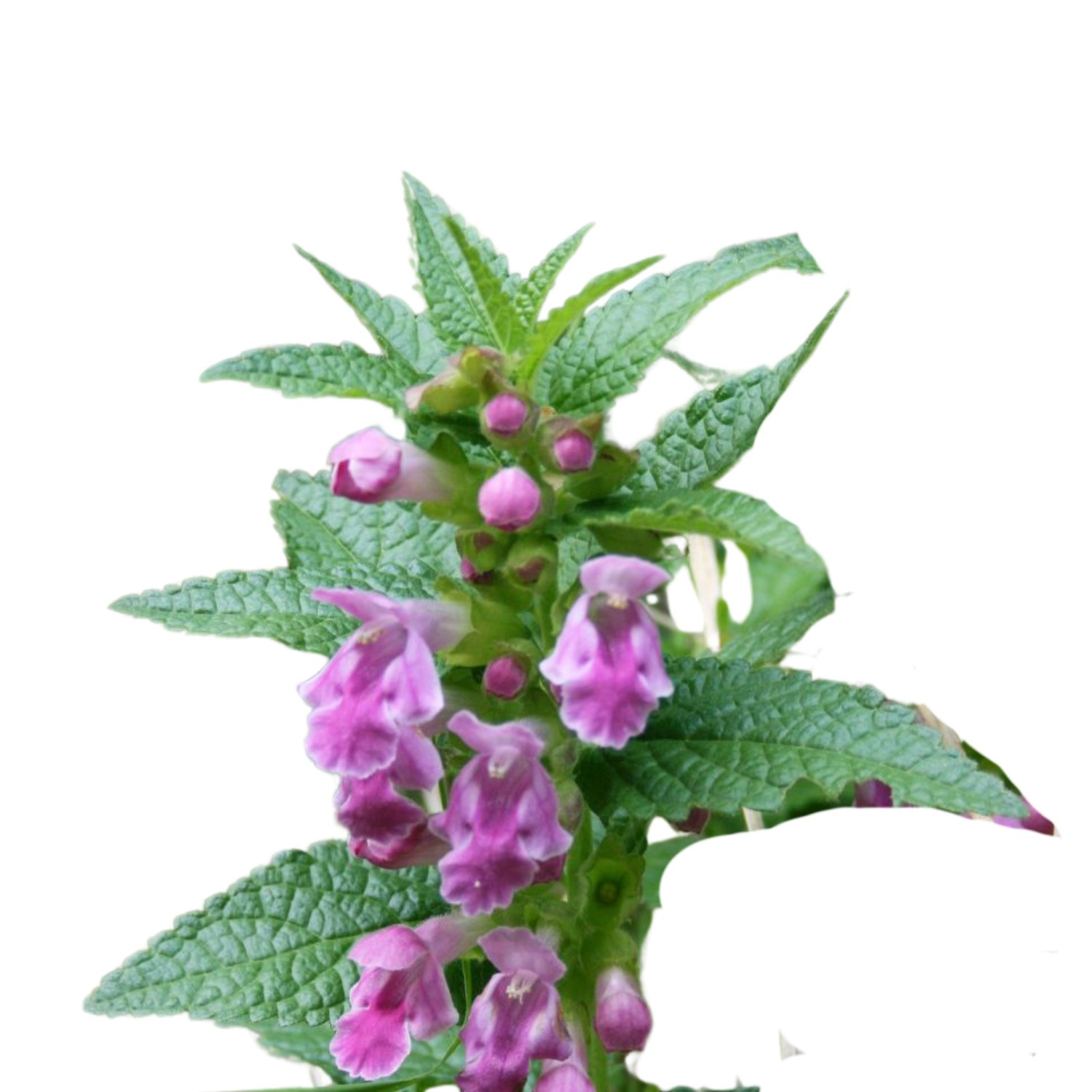
Bastard Balm
Melittis melissophyllum
Plant family
Mint family (Lamiaceae)
Season Overview
Sowing
Harvest
Harvest
J
F
M
A
M
J
J
A
S
O
N
D
1ST YEAR
FOLLOWING YEARS
Details


Light requirement
Semi-shaded

Water requirement
Moist

Soil
Light (sandy)

Nutrient requirement
Medium

Light germinator

Germination temperature
15 – 20 °C (Degrees Celsius)

Plant distance
40 cm

Row spacing
40 cm

Seeding depth
0.5 cm
Instructions
Description
The popularity of this plant from the labiate family among bees can be seen from its German names. From the month of May onwards, the immense leaf forms large, mostly white-colored flowers with a pink-spotted lower lip. The nectar secreted by this medicinal plant is so abundant that it fills the lower part of the broad corolla tube. The leaves of an immense leaf resemble the leaves of lemon balm. In contrast to the aromatic, lemon-scented lemon balm leaves, however, the leaves of the immense leaf have an unpleasant odor. The immense leaf is usually found on calcareous soils in light, warm deciduous forests and in free-standing, sunlit bushes. In naturopathy, the herb is used in a similar way to lemon balm and marjoram. In some regions, immense leaf was the most commonly used remedy for gout and bladder grit. The perennial, which grows to a height of 20 to 60 cm, usually forms simple, upright stems with soft hairs. The opposite, stalked leaves of these medicinal herbs are egg-shaped and coarsely notched to serrated. The very large, white to pink flowers of the immortelle form small groups in the leaf axils of the plant. The rhizome of the ime leaf is flat and creeping. The plant grows in central and southern Europe up to altitudes of around 1400 meters. The preferred habitat of the immortelle is sparse mixed forests, oak forests and beech forests with calcareous soils. The immense leaf has an antiseptic (germicidal), diuretic, menstruation-regulating and sedative effect. The smell of the plant is perceived as unpleasant, the taste of immense leaf is pungent and aromatic. In naturopathy, the whole plant without the roots, collected in May at the beginning of the flowering period, is used. Important ingredients of this medicinal plant are coumarin compounds.
Origin:
Central and southern Europe, sparse mixed forests, oak forests, beech forests
Growing tips
Location The ideal spot for the immense leaf should be sunny to semi-shady. Soil This perennial should be planted in a well-drained, humus-rich, calcareous, loose and sandy soil. Water requirement The water requirement is normal. Frost hardiness The immense leaf is considered frost hardy. Use This perennial is popular for group planting, but can also be used at the edge of shrubs or in natural gardens. Planting partner The immortelle harmonizes best in combination with Anemone nemorosa, Carex montana and Epimedium alpinum. Care tip Good to know: - Divide the plant every 2-3 years and remove weak roots and shoots. You will be rewarded with better growth and flowering power! - Water less frequently, but thoroughly and penetratingly. This encourages the plant roots to penetrate deeper layers of soil and help it survive dry periods. Sowing and planting If the soil is not frozen or the summer temperatures are not too hot, container plants can be planted all year round.

Companion Plants

Antagonistic Plants

Diseases
Root Rot
Powdery mildews

Pests
Land snails
Schildläuse