horse chestnut

horse chestnut
Aesculus
Plant family
- others -
Season Overview
Planting
Harvest
Harvest
J
F
M
A
M
J
J
A
S
O
N
D
1ST YEAR
FOLLOWING YEARS
Details


Light requirement
Sunny

Water requirement
Moist

Soil
Medium (loamy)

Nutrient requirement
Medium

Dark germinator

Germination temperature
20 – 25 °C (Degrees Celsius)

Plant distance
1000 cm

Row spacing
1000 cm

Seeding depth
3 cm
Instructions
Description
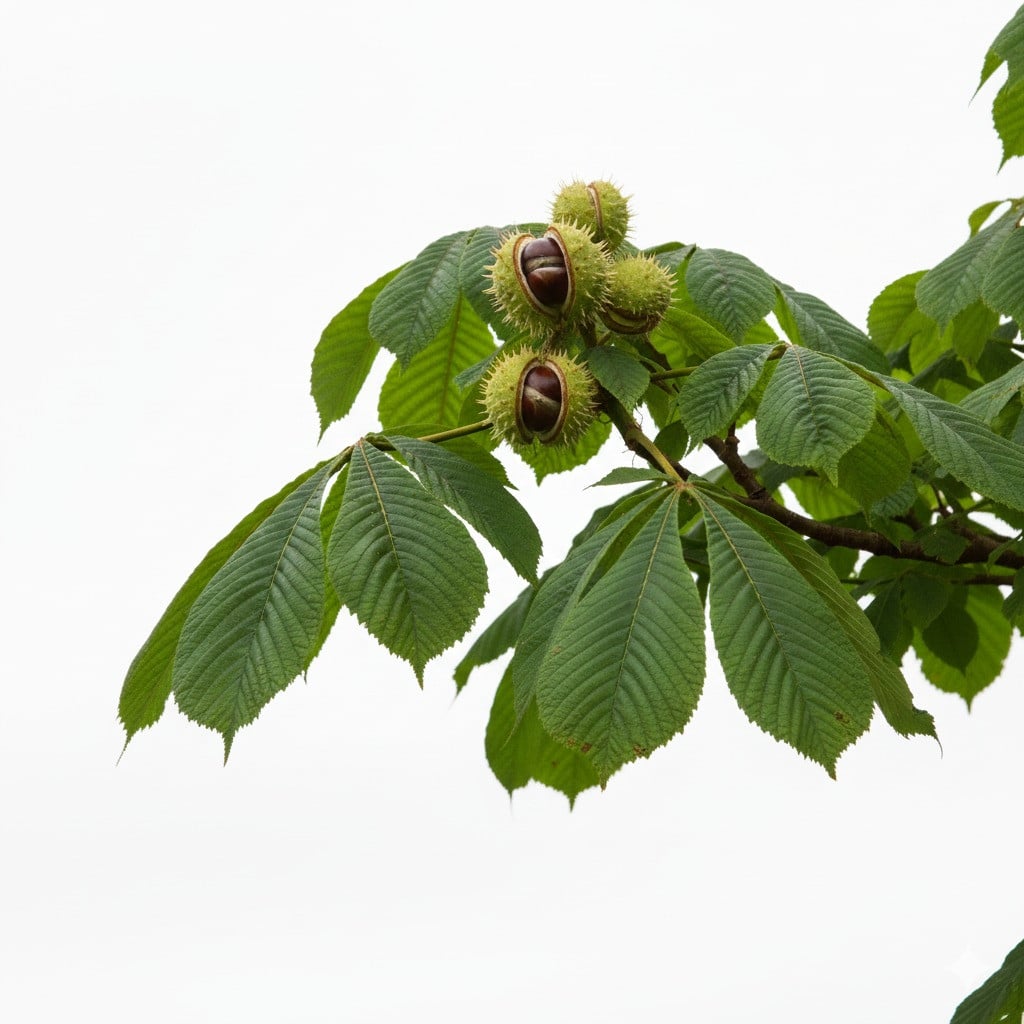
Note: The sweet chestnut (Castanea sativa) is not related to the horse chestnut, even though the fruits are similar. The sweet chestnut belongs to the beech family (Fagaceae). Horse chestnuts are deciduous and grow either as trees or shrubs. Their size varies greatly depending on the species and variety and ranges from small shrubs around three meters high to trees 30 meters tall. The color of the bark can range from grey to dark brown, sometimes it is completely smooth, sometimes it flakes off in a scaly manner. The foliage is made up of five to nine leaflets, which are arranged in a finger-like pattern and look very decorative. The edge is serrated and the leaf blade is either bare or tomentose. In the fall, the leaves turn yellow or red before they fall off. The flowers of Aesculus are either hermaphrodite or male. The flower color is usually white or yellowish, but some species and varieties also bloom in soft pink or bright red. The flowers grow in upright, dense, large and terminal panicles - and are a real feast for the eyes. The many insects for which horse chestnuts are valuable food plants also find this to be the case. Pollination is carried out by bees and bumblebees. After successful pollination, the fruit capsules develop. Their fruit shell is brownish or green, sometimes covered with spines. The seeds inside, colloquially known as chestnuts, can be up to four centimetres thick, are shiny dark brown or reddish brown in color and have a light-colored navel. They are spherical in shape, with one side always slightly flattened. Please note: Unlike sweet chestnuts, the fruits of Aesculus are not suitable for consumption, but are slightly poisonous - however, they are excellent for wildlife and livestock feed. Horse chestnuts are undoubtedly among the most beautiful of all woody plants. Their large crowns provide shade - not to mention the decorative foliage - the flower candles are a unique sight and the fruits are only too happy to be collected and used for handicrafts or decoration. The common horse chestnut is mainly planted as a park and street tree - but it is also known from beer gardens. The sterile variety 'Baumannii' is usually used as roadside greenery, as the falling fruits of this wild species can endanger pedestrians and damage parked cars. The red-flowering horse chestnut is suitable for large gardens as a house tree. The lower shrub horse chestnut needs a lot of space due to its tendency to spread and can therefore usually only be admired in parks. Only the Karolina horse chestnut is suitable as a solitary tree in smaller gardens.
Origin:
Europe, North America, Asia
Growing tips
Location and soil Horse chestnuts thrive in full sun, partial sun or partial shade - depending on the species. What they all have in common, however, is that they are sensitive to dry air and soil and cannot tolerate road salt, exhaust fumes or urban climates. If the root area is subsequently paved over, this will severely damage the shrubs. Soil compaction is generally not tolerated; deep, loose, fresh and nutrient-rich soil with good drainage is better. Planting To avoid any unpleasant surprises, it is important to know exactly how tall (and wide) the horse chestnut will ultimately grow before planting. The final growth size can usually be found on the plant label. Bear in mind that this can involve distances of more than twelve meters! The right time to plant horse chestnuts is in spring, i.e. at the end of May, when the last frosts of the year have passed. Before planting the tree in the ground, place the root ball in a bucket or trough of water for several hours - if no more air bubbles appear, it is completely saturated with liquid and ready for planting. Loosen the soil at the planting site thoroughly and, if it is very compacted, mix it with some coarse sand or gravel. The excavated soil should be improved with mature compost before refilling. Its high humus content helps it to grow and ensures that the soil can retain moisture better. Do not place your horse chestnut deeper into the planting hole than it was previously in the pot. If it is a grafted variety, the grafting point must be a good ten centimetres above the soil. Finally, press the soil down firmly and thoroughly tamp it down. Tip: Some types of Aesculus grow better if you give them a support stake for the initial period. Care tips In view of their magnificent appearance and size, horse chestnuts are surprisingly frugal when it comes to care. It is sufficient to apply a little compost or horn shavings to the root area every spring to provide nutrients. However, young plants should be watered during longer dry periods in the first few years so that their roots can develop properly. Ideally, low-lime to lime-free water should be used. If excessive spreading is not desired, the runners of some species, such as the shrub chestnut, must occasionally be dug out and pruned. Pruning The shrubs do not need pruning - they should be left to grow as undisturbed as possible so that they can develop their natural crown shape. Only dead branches on old specimens need to be removed occasionally. If they grow too densely, they can be thinned out in late winter. Winter protection Horse chestnuts are sufficiently hardy for our climate. The different species and varieties of Aesculus can be assigned to hardiness zones 4 (-28 to -34 degrees Celsius), 5 (-23 to -28 degrees Celsius) or 6 (-17 to -23 degrees Celsius). Propagation Tree-shaped horse chestnuts are propagated by grafting, a method that is not easy for amateur gardeners. The shrub horse chestnut, on the other hand, can be easily propagated by runners. These can be cut off with a spade and replanted elsewhere. The best time to do this is in spring or fall.

Companion Plants

Antagonistic Plants
Diseases
Powdery mildews
Pests
Aphids