Freesia

Freesia
Freesia
Plant family
Iris family (Iridaceae)
Cultivation Break
0 Years
Season Overview
Propagating
Planting
Harvest
Harvest
J
F
M
A
M
J
J
A
S
O
N
D
1ST YEAR
FOLLOWING YEARS
Details


Light requirement
Sunny

Water requirement
Moist

Soil
Light (sandy)

Nutrient requirement
Medium

Dark germinator

Germination temperature
20 - 25 °C (Degrees Celsius)

Plant distance
10 cm

Row spacing
15 cm

Seeding depth
7 cm
Instructions
Description
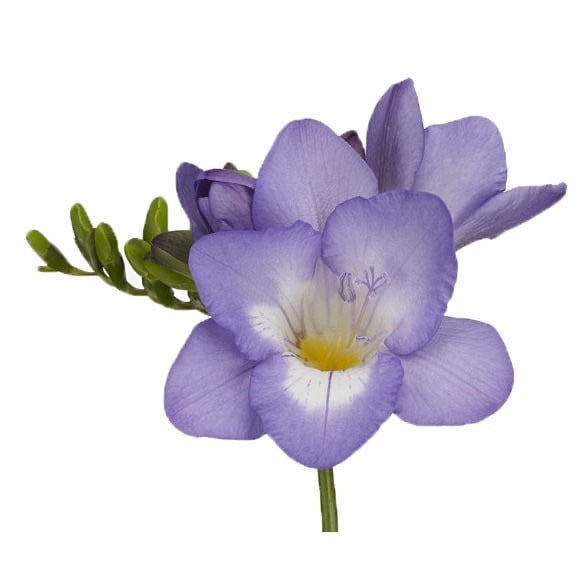
Freesias are decorative flowering plants with elegant, funnel-shaped flowers that appear in loose inflorescences. They are particularly known for their intense, pleasant fragrance and bloom from spring to summer, depending on when they are planted. The flowers come in many colors such as white, yellow, pink, red or purple. Freesias grow from tubers, prefer warm, sunny locations and are often used as ornamental plants in beds, pots or as cut flowers.
Origin:
South Africa (coastal regions)
Growing tips
Freesias prefer a sunny to semi-shady location with loose, humus-rich and well-drained soil. The tubers are planted in spring after a frost-free winter or after pre-growing from February/March, with a planting distance of 8-10 cm and row spacing of 15-20 cm. During the growing and flowering period, they should be kept evenly moist and waterlogging should be avoided at all costs. Freesias have medium nutrient requirements and benefit from occasional fertilization with organic flowering plant fertilizer or compost. After flowering, the leaves should be completely retracted so that the tubers can be dug up in the fall and stored in a dry and frost-free place. The plants are considered to be robust, flower-rich and are suitable for flower beds, pots and as cut flowers.

Companion Plants

Antagonistic Plants

Diseases
Septoria
Grey mold
Brown rot

Pests
Thrips
Land snails
Flea beetles
Aphids